What Is the Best Car Topper Boat?
And why RackRider is the best car topper boat on the market
A car topper boat promises a real boat without the trailer. No rego, no bearings, no ramp queues, nothing dragging behind the car when the van is on the towbar. But “car topper” covers everything from a $900 inflatable to a purpose-built composite hull, so what is the best car topper boat? The honest answer is the one you can actually get on and off your roof by yourself, year after year. Here is how the options stack up against that test.
What makes a good car topper boat?
Before comparing types, agree on the job description. A genuine car topper needs to do five things well:
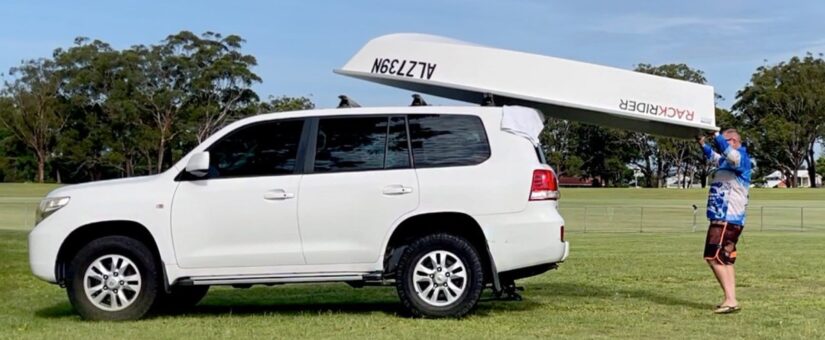
Be light enough to load repeatedly. A boat you can technically lift once with a mate is not a boat you will load alone at 5 am. For one-person loading on standard racks, a hull under about 50kg is the realistic ceiling for most people.
Stay stiff and quiet on the water. Weight savings should not mean a hull that flexes and slaps.
Carry a useful load: two adults, safety gear, fuel and a day’s kit. Check the rated capacity, not just the length.
Run on a small, simple motor. A hull that performs on 4 to 6hp keeps the whole rig light, cheap and low-maintenance.
Survive Australian conditions: UV, salt and gravel roads
Aluminium tinnies
The traditional choice, and still a good boat. The problem is the arithmetic. To keep a 3.5 to 3.9m tinnie stiff enough, most models land somewhere above 55kg, often well above, before the motor goes on. That puts genuine solo roof loading out of reach for most people without a loading system, which adds cost, weight and complexity to the vehicle. Thin-gauge car topper tinnies exist, but thin aluminium flexes, drums and dents.
If you already run a side loader and love the classic feel, a light tinnie still makes sense. If you do not, keep reading.
Inflatables
Unbeatable on weight and stowage: many pack into the boot entirely, and there is nothing to put on the roof at all. The trade-offs arrive at the water. Set-up and pump-up time every session, vulnerability around oysters, hooks and rocky banks, UV degradation over years in the Australian sun, and a wet, flexy ride once the wind gets up. As a tender or an occasional-use boat, excellent. As a primary fishing boat you use every week, limiting.
Folding and sectional boats
Clever answers to the storage problem, but every join is a compromise: assembly time at the ramp, seals to maintain, and hulls that rarely match a one-piece boat for stiffness or lifespan. Fine for occasional use. Fiddly as an everyday platform.
Composite foam-core car toppers
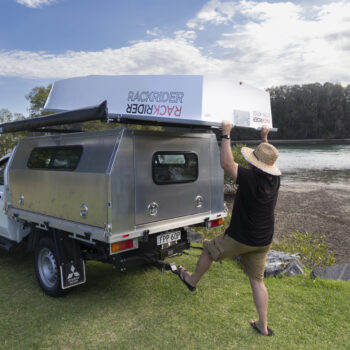
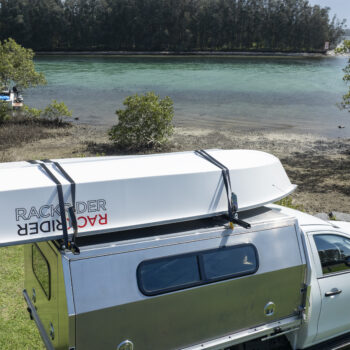
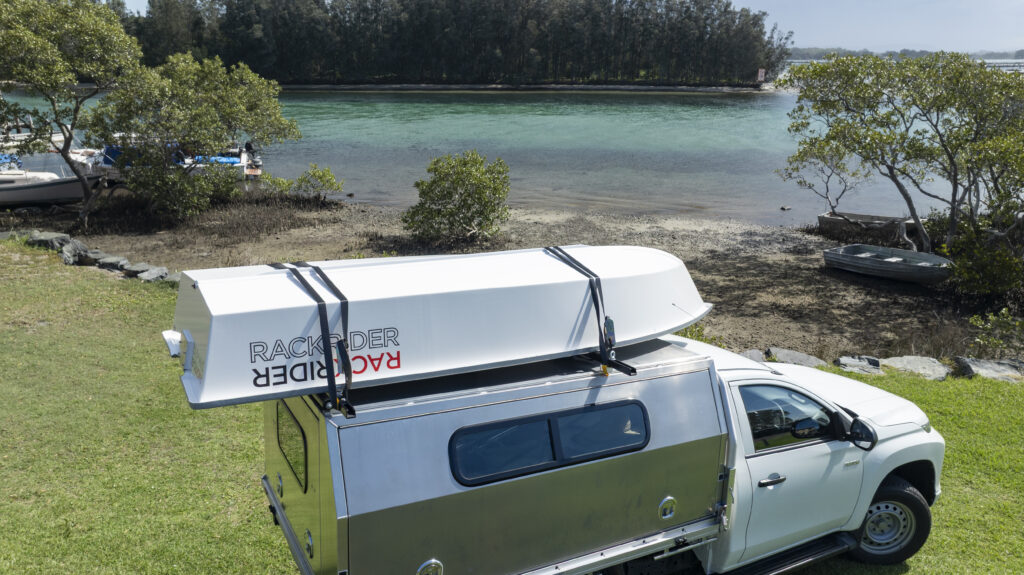
The newest category, and the one designed specifically for the job description above. Resin infusion fuses gel coat, fibreglass matting and a foam core under vacuum into a one-piece hull that is genuinely light, stiff, quiet, corrosion-proof and naturally buoyant. Our RackRider 3.7 hull weighs 48kg, carries 295kg, and does about 30km/h on a 6hp outboard at better than 10km per litre. Nothing to inflate, assemble or fold: lift it off the racks and go.
The trade-off is honest too. Composite car toppers are optimised for portability and simplicity, not heavy offshore work or hanging a dozen accessories off the gunwales. Estuaries, rivers, dams and calm bays are their country.
Don’t forget the rest of the rig
The best car topper boat is really the best car topper system. Check your roof racks’ rated capacity and your vehicle’s roof load limit against the hull weight: a 48kg hull sits comfortably within most quality rack systems, an 80kg tinnie usually does not. Pick a modern 4 to 6hp single-cylinder outboard, around 27kg and roughly $2,000 new, that lifts in and out easily. And practise the load at home, because a boat that takes two people to load will quietly stop getting used.
Be honest about your water, too. If your plans are genuinely offshore, no car topper does that job, ours included. Buy a trailer boat and enjoy it.
Our verdict
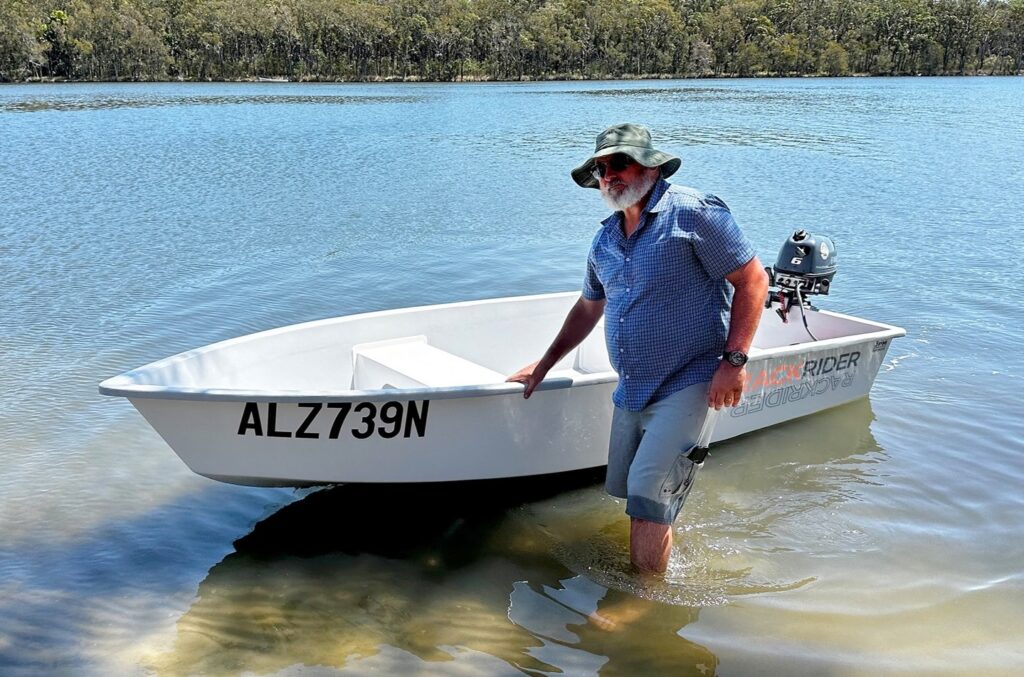
For a shed boat that packs flat, buy an inflatable. For side-loader owners who love aluminium, a light tinnie still earns its keep. But if the question is which car topper boat one person can load, launch and fish from year after year, a purpose-built composite hull is the strongest answer the category has produced, and it is exactly why we build the RackRider 3.7 the way we do: 3.7m, 48kg, two people, 295kg of load, designed and supported in Forster, NSW.
Frequently Asked Questions
How heavy is too heavy for a car topper boat?
The practical test is whether you can load it alone, every time, without dread. For most adults, that caps hull weight around 50kg on standard racks. Above that, you are into mechanical-loader territory, which works but adds cost and complexity to the vehicle. Always check your vehicle’s roof load limit too, since it applies while driving.
Do I need special roof racks for a car topper boat?
Usually not for a sub-50kg composite hull: most quality rack systems on wagons, utes and 4WDs carry that comfortably. Confirm the rack rating and your vehicle’s roof load limit in the handbook, and space the crossbars as wide as the roof allows for stability on rough roads (we recommend around 1200mm apart).
What size motor does a car topper boat need?
For an efficient hull under 4m, a 4 to 6hp single-cylinder outboard is the sweet spot: around 27kg to carry, roughly $2,000 new, minimal servicing, and enough to push a light composite hull between 23 to 30km/h depending on the load. Bigger motors add lifting weight at each end of the day.
Are car topper boats safe?
Used on the water they are designed for, yes. A stiff hull with positive foam flotation, sensible load limits and standard safety gear handles estuaries, rivers, dams and calm bays well. The risks come from using any small boat outside its design brief, so match the boat to your water and check conditions before launching.
Wondering whether the RackRider 3.7 suits your vehicle and your water? Send your enquiry or call RackRider for a straight answer
About the Author
Phil York, Founder and designer, RackRider
Phil designed the RackRider 3.7 around one problem: getting a real boat onto a roof rack without a second pair of hands. He has loaded and unloaded it on his own on tracks from Forster to the Kimberley, and he built the boat the way he did because nothing on the market was light enough for his own vehicle. If you want to talk through whether a car topper boat suits your rig, he is the one who answers the phone.