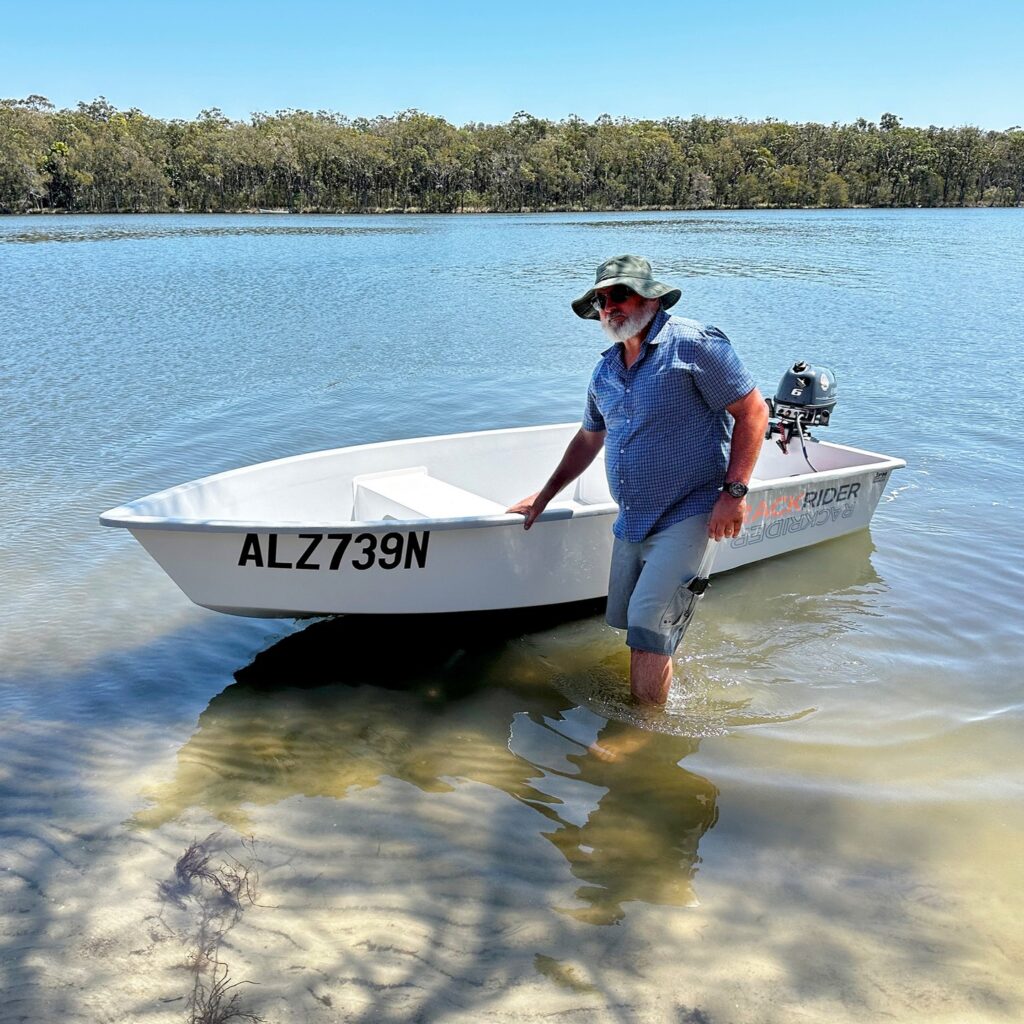
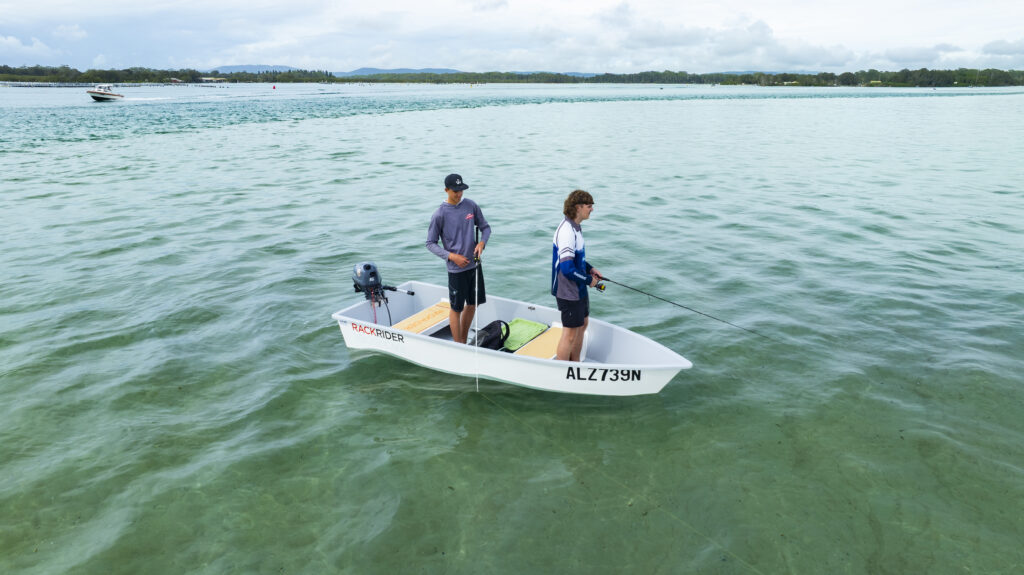
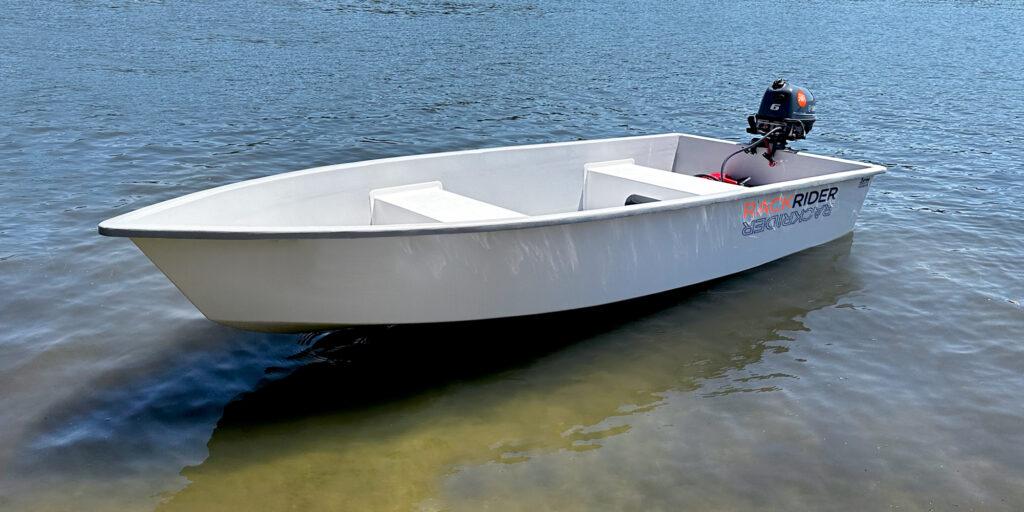
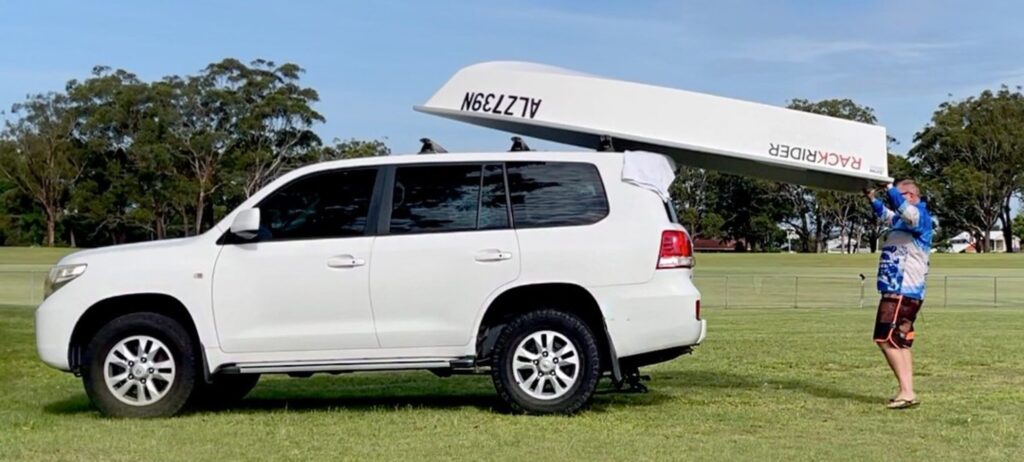
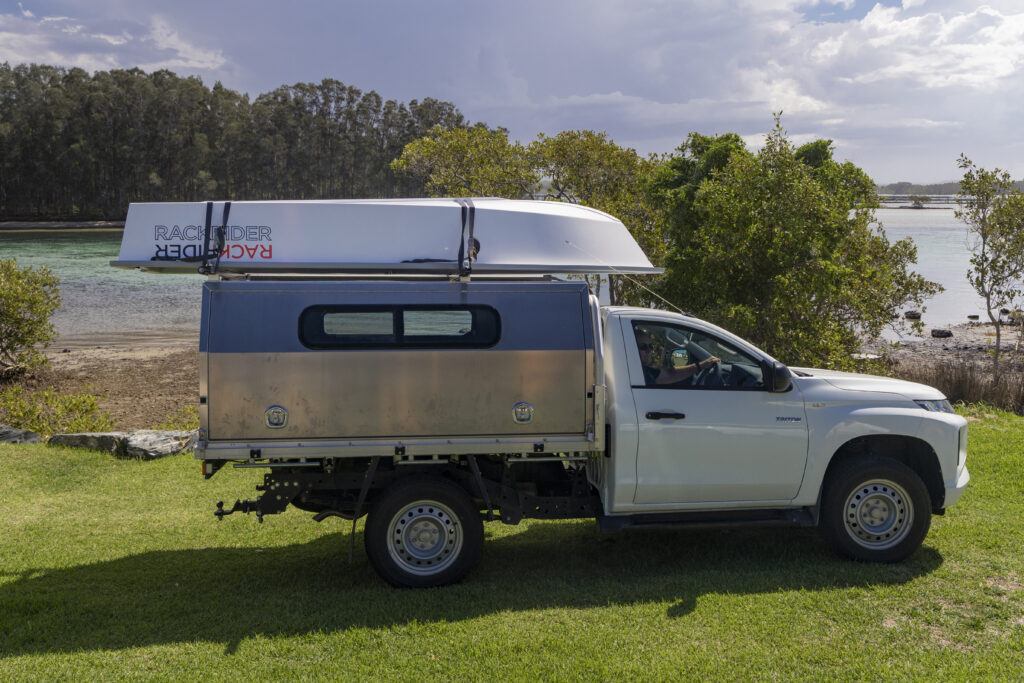
The RackRider 3.7 is a 3.7 metre long car topper boat with a hull weighing just 48kg: light enough for one person to slide onto standard roof racks, rigid enough to carry two adults and 295kg of load. No trailer, no rego queue at the ramp, nothing hanging off the back of the car when you are towing the van. Get the boat off the roof and onto the water before your coffee goes cold.
Most light boats save weight with thin aluminium, and you feel it in the flex, hull slap and dents. The RackRider 3.7 gets its 48kg from resin-infused, foam core construction instead. Gel coat, fibreglass matting and a foam core are fused under vacuum into a single stiff hull that runs quiet, floats even when swamped thanks to the foam core, and never corrodes.
It is the construction method used in high-end marine builds, applied to a boat you can lift.
Deleting the trailer deletes its costs and its friction. No trailer registration or insurance, no bearings and brakes to maintain, no ramp queues, and your towbar stays free for the caravan. The RackRider 3.7 rides on roof racks you may already own, launches anywhere you can carry it to the water’s edge, and its little single-cylinder outboard sips fuel and rarely sees a mechanic.
That is why the boat was designed around light weight, ease of use, simplicity, frugality and long range, and why it has found a home with caravanners, remote-country travellers and estuary fishos.

The RackRider 3.7 is deliberately not a heavy-weather offshore rig or an accessory-laden bass boat. It trades load capacity and rough-water ambition for portability and simplicity. Estuaries, rivers, dams and calm bays are its country, and within that country it is very hard to beat. If your plans are 20km offshore, it might be worth buying a trailer boat. We will tell you the same on the phone.
Wondering how it compares with a tinnie or an inflatable? Read our blog post on what is the best car topper boat before you decide.
Yes, that is the design brief the boat was built to. The hull weighs 48kg. You need to be able to lift 30 kg above your head to load the boat onto the roof, as the front of the boat is supported on the roof rack and you are only lifting the back. This is something to consider before buying if you are aging or of smaller stature. It slides onto standard roof racks without a mechanical loading system. Most owners develop a one-person routine within a few sessions. If you want to see the technique before buying, watch our RachRider Loading Tutorial” YouTube video or call +61 428 840 119.
Most quality roof rack systems on wagons, utes and 4WDs are rated well above 48kg, but check your specific racks and your vehicle’s roof load limit in the handbook, as the limit applies while driving. Add tie-down points front and rear. We can talk through your vehicle setup before you order.
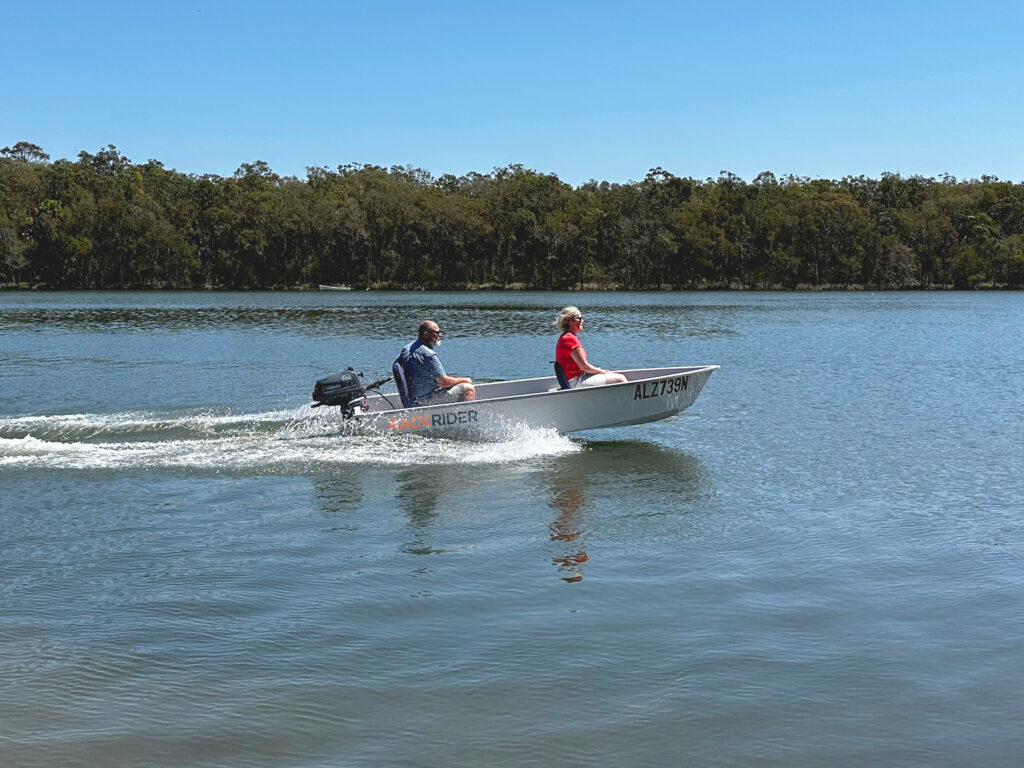
A 4 to 6hp single-cylinder outboard is the sweet spot. Around 27kg to lift, roughly $2,000 new, and enough to push the hull to about 30km/h while returning better than 10km per litre. Bigger motors add weight at both ends of the day. Watch our RackRider Motor Selection YouTube video for an in-depth discussion on this matter.
Expect up to 30km/h with a 6hp outboard and a light load, and fuel economy better than 10km per litre. On a standard 11-litre tank, that is a genuine day of estuary or river range. The hull’s efficiency is the point for long range from a small, cheap, simple motor rather than outright speed.
No, and we would rather tell you now than after you buy. It is a 3.7m, 48kg boat designed for estuaries, rivers, dams and calm bays with two people aboard. It handles those waters well, but it is not built for open ocean work. If offshore is your plan, a trailer boat is the right tool.
In NSW, if you operate with an engine greater than 5hp, you will need to register the boat. It pays to independently check the current NSW Maritime requirements for your setup. There is no trailer to register either way, which is where most of the ongoing savings sit. We can point you to the right information when you order. Another thing to consider is that if the boat can travel faster than 10 knots (18.5km/h), you will need a boat licence to operate the boat. That means that unless you are using a 2.5hp engine, a licence will be required. These are the current NSW laws. If you live in another state, please consult the relevant authorities regarding boat registration and boat driver licensing laws.
Tell us where you are headed and how you like to travel. We will help you choose the right engine setup and sort delivery to your door.