How To Load A Boat On A Roof Rack
How do you secure a boat to a roof rack?
Use four points, not two. Run one strap over the hull at each crossbar, looping it under and around the bar, so it captures the boat and bar together. If you want more stability, run a line from the bow to a tow point at the front and another from the stern to the rear. Straps hold the boat down. Bow and stern lines stop it from moving. The bow and stern straps may not be required if your roof racks are at least 1200mm apart.
Tie down over the hull to the crossbars
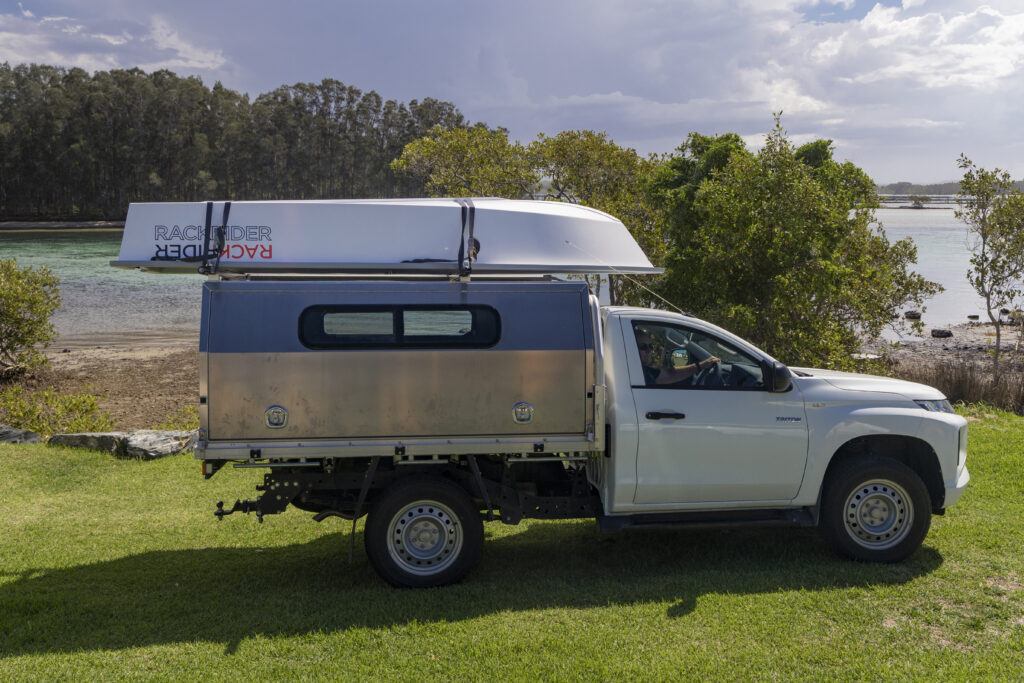
Throw the strap over the boat, pass the end under the crossbar, bring it back up and buckle it on top of the hull rather than against the paint. Keep the buckle off the gunwale edge where it chews the finish. Centre the hull, tighten each strap evenly, then shove the boat sideways and fore and aft. A load that is properly secured moves the whole car. Take care not to tighten the ratchet strap too much. You want them firm enough to securely hold the boat, but not so tight as to damage the hull.
Should you use ratchet straps or cam straps?
It depends on the hull, and this is where advice written for kayaks gets misapplied. Cam straps cannot generate much force, which is why they suit a flexible plastic kayak: you cannot crush the hull with one. A ratchet gives you far more pull, and on a soft kayak, that is a liability. On a rigid boat built for it, a ratchet is right. RackRider specifies a pair of 35mm ratchet straps for the 3.7. Follow the manufacturer and stop tightening once the boat stops moving.
Do you need bow and stern lines?
Yes, and they are the most skipped step of the lot. At highway speed, the wind tries to lift the bow, and a strap over the hull can be aided by a bow strap. A bow line anchors the bow to the car itself, so if a rack foot lets go, you still have your boat. Run them at roughly 45 degrees to a tow point, never to a plastic bumper. Keep them taut only. You can pull a hull out of shape.
Staying Legal And Safe On The Road
Australian load restraint and overhang rules
Load restraint law requires your load to be held so it cannot move, and it must not obscure your lights, indicators or number plate. There are projection limits, too. On a car, a load can extend up to 1.2m in front and no more than 150mm past either side, with a total width capped at 2.5m. Rear overhang is limited to 60% of your wheelbase or 3.7m, whichever is shorter. A 3.7m boat on a short wheelbase 4WD gets closer to those numbers than people expect, so measure.
When you need a flag
If your load projects more than 1.2m behind the vehicle, attach a brightly coloured flag at least 300mm by 300mm to the end of it, and a red light instead at night or in poor visibility. The Australian Road Rules are broadly consistent nationally, but detail varies by state, and Western Australia treats rear projections differently, so check your transport authority before a long trip.
Checking your load along the way
Straps bed in and settle. Drive a few hundred metres, pull over somewhere safe and check every strap and line again, because that first short drive is when a load that felt tight turns out not to be. Then check at every fuel stop. Watch your clearance too, which catches out drivers used to towing a trailer.
Please note: Securing a load safely, within your vehicle manufacturer’s limits and your state’s road transport legislation, is the driver’s responsibility. This guide is general information, not a substitute for your owner’s manual or your state’s rules.
Why The RackRider Makes This Easy
48kg and no loading system
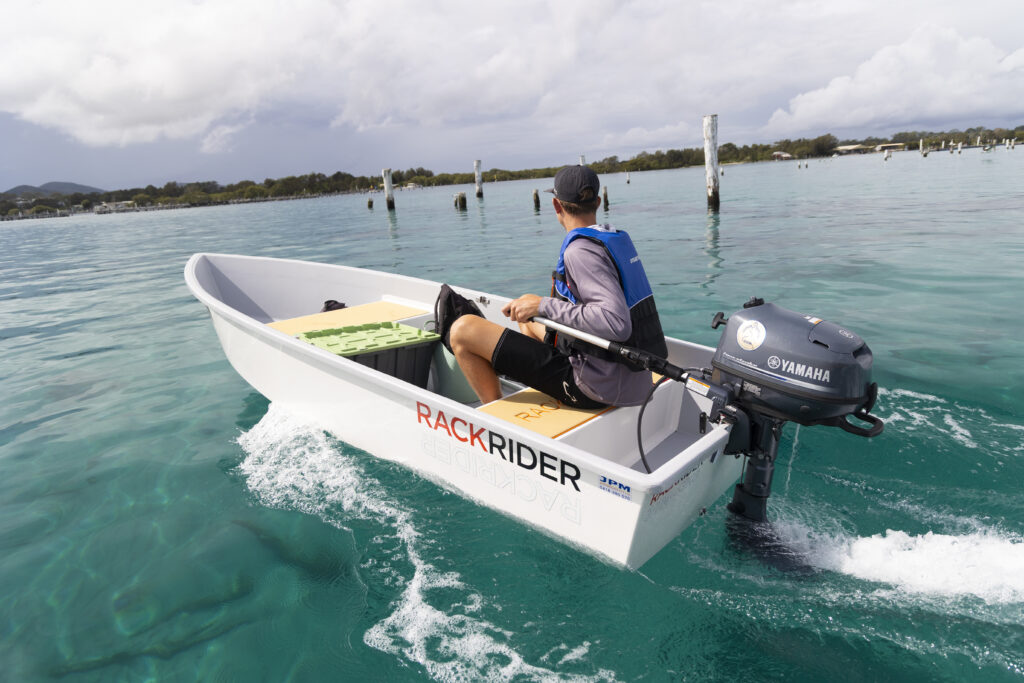
Everything about how to load a boat on a roof rack, and how to secure it once it is up there, comes back to weight. The RackRider 3.7 is 48kg from the factory, roughly half what many 3.7m tinnies weigh, designed that way so one person could handle it with no rooftop loading system. It also sits inside the dynamic roof load limit of most vehicles rather than right on it.
A rigid hull and two ratchet straps
The hull is resin infused foam core, stiff enough to take a pair of 35mm ratchet straps without deforming the way a soft kayak would. Two straps over the hull, a bow line if you deem it necessary, and the boat is secure. It fits a standard roof rack with 1.4m of bar width and about 1200mm of spacing, so on most rigs, there is nothing to buy. That is the point of a car topper boat.
One piece of advice from Phil
Don’t pay a premium for a light car topper boat and then hang 15kg of accessories off it. The point is the weight, and every bracket and rod holder is the weight you lift onto your roof. Keep it simple, and the boat stays as easy to load in three years as on day one.
If you want a boat that goes up solo without a loading system, the RackRider 3.7 is 48kg and $7,800 RRP. Send an enquiry with your suburb, and Phil will come back with pricing and delivery.