
Frequently Asked Questions
Got questions about the RackRider 3.7? Find straightforward answers about its specifications, roof-rack compatibility, loading, performance, safety, ownership and more.
Browse by topic
Capacity & Specifications
How much does the RackRider 3.7 weigh?
The RackRider 3.7 weighs approximately 48kg as it leaves our factory, light enough for one person to load onto a standard roof rack with a bit of technique. That’s significantly lighter than many 3.5–3.9m aluminium tinnies, which can weigh twice as much and may require a second person or mechanical loading system.
The lightweight design is intentional, making the RackRider 3.7 easier to transport, load and launch. If you’re smaller in stature, ageing or managing an injury, having a second person help with loading can still make the process easier.
To keep handling straightforward, we recommend avoiding unnecessary weight from heavy accessories. Adding 10–15kg of equipment can quickly reduce some of the benefit of having such a lightweight hull.
How much can the RackRider 3.7 carry, and how many people fit?
The RackRider 3.7 weighs approximately 48kg as it leaves our factory, light enough for one person to load onto a standard roof rack with a bit of technique. That’s significantly lighter than many 3.5–3.9m aluminium tinnies, which can weigh twice as much and may require a second person or mechanical loading system.
The lightweight design is intentional, making the RackRider 3.7 easier to transport, load and launch. If you’re smaller in stature, ageing or managing an injury, having a second person help with loading can still make the process easier.
To keep handling straightforward, we recommend avoiding unnecessary weight from heavy accessories. Adding 10–15kg of equipment can quickly reduce some of the benefit of having such a lightweight hull.
What are the dimensions of the RackRider 3.7?
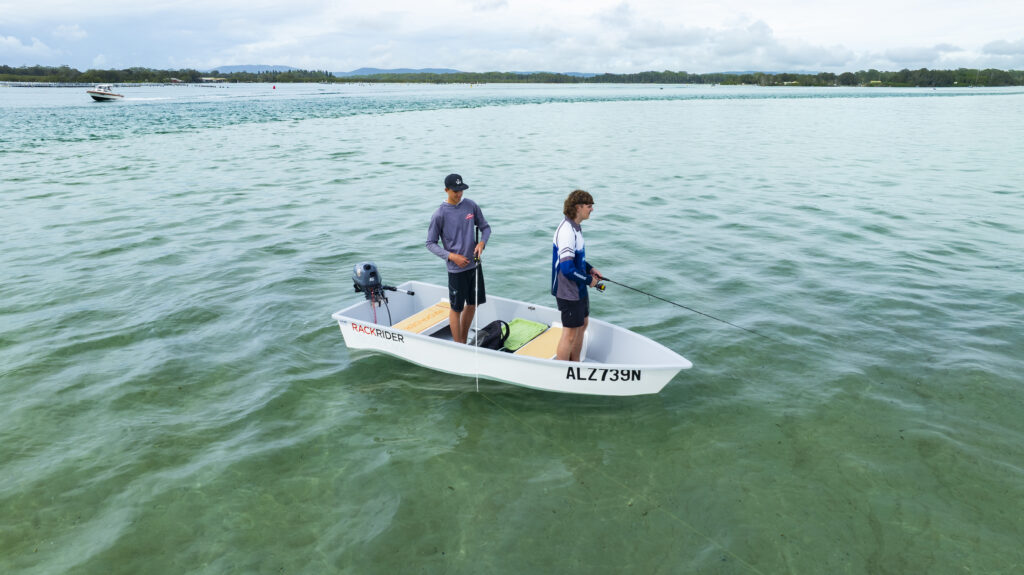
The RackRider 3.7 is 3.7m long with a 1.32m beam and a shallow draft. That beam is wide enough to carry two people at speed without feeling tippy, while the shallow draft gets you into skinny creeks and impoundments that are usually left to canoes and kayaks.
What's included when I buy a RackRider 3.7, and what do I need to buy separately?
Your RackRider 3.7 arrives as a complete hull with moulded-in seats, ready to fit an outboard. The outboard motor, fuel tank and ratchet straps are bought separately, since everyone’s vehicle and budget differ, and we’ll point you to our tested recommendations rather than mark up gear you may already own.
Optional extras like oars, an anchor, flooring and rod holders can be added from day one or later, whichever suits you.
Not sure the numbers stack up for your trip?
Tell Phil what you’re planning to carry and where, and he’ll help you work out whether the RackRider 3.7 is the right fit for your setup.
Roof Racks & Vehicle Compatibility
Will the RackRider 3.7 fit my car, ute or 4WD?
The RackRider 3.7 is specifically designed to work with standard roof racks, making it suitable for a wide range of cars, utes, wagons and 4WDs.
Your vehicle will need roof racks with a minimum bar width of 1.4m and approximately 1200mm between the bars. You’ll also need to make sure your vehicle’s dynamic roof load rating can safely accommodate the complete setup. There is a video on the RackRider YouTube channel titled “Strapping the RackRider down onto Roof racks” that will be of interest.
If you’re unsure whether your vehicle is suitable, send us your make, model and current roof rack setup, and we’ll give you an honest answer.
What roof racks do I need for the RackRider 3.7?
The RackRider 3.7 is designed to sit on standard car roof racks, no rooftop boat-loading system is required. We recommend:
- Minimum bar width: 1.4m
- Approximate bar spacing: 1200mm
- Roof racks suitable for the weight of the complete setup
- A vehicle with a sufficient dynamic roof load rating
Your actual limit comes from your vehicle’s own roof load rating, not your rack, so check your owner’s manual before you order. Most vehicles allow between 50kg and 100kg dynamically (while driving). Securing the boat safely and within your state’s road transport rules is your responsibility.
We’ve written a full step-by-step guide covering exact roof load ratings and Australian load restraint rules.
Do I need special or expensive roof racks?
Usually, no. At approximately 48kg, the RackRider 3.7 is light enough for many quality factory or aftermarket roof rack systems to handle without requiring a proprietary boat loader or mechanical loading system.
That’s one of the major advantages of our lightweight car topper. Heavier aluminium tinnies can put significantly more demand on your vehicle and may require additional equipment to get them safely onto the roof.
How do I know if my vehicle's roof load rating is high enough?
Check your owner’s manual for the dynamic roof load rating, this is the figure that applies while driving and is usually lower than the static rating you’ll see for a stationary rooftop tent. Add up the weight of your rack, the boat, straps and anything else you carry up there. If that total sits under your vehicle’s dynamic rating, you’re set.
A 48kg hull leaves meaningful headroom on most vehicles.
Will the RackRider 3.7 fit a small car or sedan?
Provided your vehicle has roof racks meeting the 1.4m bar width and roof load rating above. RackRider designed this boat after discovering most car-toppers on the market were too wide and too heavy for a sedan. The main problem will be getting your roof bars spaced far enough apart (we recommend 1100 to 1200mm between your front and rear roof rack bars). This can be solved with a fabricated “t” bar fitted to a towball. If you’re unsure, send us your vehicle make and model, and we’ll help you.
A 48kg hull leaves meaningful headroom on most vehicles.
Loading & Transport
How do I secure the RackRider 3.7 to my roof rack?
Securing the RackRider 3.7 is simple. Two 35mm ratchet straps run over the hull and around each crossbar, providing the tested and recommended method for securing the boat to your roof racks.
For longer touring trips or extended highway driving, some owners choose to add bow and stern lines for extra security. You can also add additional fixing points if they suit your vehicle and setup.
There is a video on the RackRider YouTube channel titled “Strapping the RackRider down onto Roof racks” that will be of interest.
Always ensure the boat is secured in accordance with your vehicle manufacturer’s requirements and applicable Australian load restraint regulations.
Can I really load and unload the boat by myself?
Yes, and exactly why RackRider was designed. At 48kg, one person can lift the RackRider 3.7 on and off a standard roof rack using a simple rest-and-slide technique, without a loading system or a second set of hands. Of course, as we age, lifting can become burdensome, so take this into account. If you are getting older but travel with a companion, then a 2-person lift will make life much easier.
A trolley can also make moving the boat from your vehicle to the water much easier, particularly when you’re covering a longer distance.
Can I tow a caravan and carry the RackRider 3.7 at the same time?
Yes. That’s one of the key advantages of a roof-mounted boat.
Because the RackRider 3.7 sits on your vehicle’s roof rather than taking up the tow ball, you can keep your towbar free for your caravan, trailer or other towable gear.
That means you don’t have to choose between taking your boat and towing your caravan. You can take both on the same trip!
Engines & Performance
What size outboard motor does the RackRider 3.7 need?
The RackRider 3.7 is designed for short-shaft outboards in the 4–6hp range, with an ideal motor weight of around 25–27kg.
For most users, we recommend a 6hp outboard. It weighs around the same as a 4hp motor but provides approximately 50% more power, which makes a noticeable difference when carrying two people and gear.
A 2.5hp outboard is a lighter option, weighing around 12–17kg, so it’s easier to lift and carry on your own. However, it won’t get the RackRider 3.7 up onto the plane. Instead, you’ll travel at slower speeds, making it a good choice for relaxed, fuel-efficient trips on rivers, creeks and other waterways.
Please see our “RackRider motor selection video” on our RackRider YouTube channel.
How fast does the RackRider 3.7 go, and how much fuel does it use?
With a 6hp outboard, the RackRider 3.7 planes at up to 30km/h with one lightish person on board. With 2 people and gear weighing around 200kg the boat will travel at about 23km/h. Fuel economy is well over 10km per litre, so an 11-litre tank gives you more than 100km of range.
These figures come from our own on-water testing, not a manufacturer’s spec sheet estimate.
Do you supply the engine, or do I buy it separately?
At this stage, RackRider does not supply engines or accessories directly. We keep the boat itself as light and simple as possible, and let you choose the gear that suits your own rig and budget.
Not sure whether to go 4hp or 6hp?
Tell us how many people you’ll usually carry, and we’ll recommend the right size.
Safety & Where You Can Use It
Where can I use the RackRider 3.7?
The RackRider 3.7 is designed for protected waterways and fair-weather conditions, including:
- Rivers and creeks
- Estuaries
- Lakes and dams
- Sheltered bays
Its shallow draft also allows you to explore shallow water that larger boats may struggle to reach.
The RackRider 3.7 is not designed for open ocean, offshore trips or rough conditions. At 3.7m, its size, beam and freeboard make it best suited to calm, protected water.
If you’re planning regular offshore trips, we’d recommend choosing a larger, heavier boat that’s designed for those conditions.
Do I need a boat licence to drive the RackRider 3.7?
In NSW, boats travelling at more than 10 knots (18.5km/h) require you to be licenced. This means that if you use motors in the 4 to 6hp range, you will require a licence. If you use electric propulsion or a 2.5hp petrol motor, you will not need to be licensed to drive the boat
In Victoria, any boat with a motor will require you to be licenced to drive the boat.
In Queensland, only boats with engines greater than 6hp require licensing so you will not need a licence to drive the boat in Queensland.
Please verify this information with your local state authority.
Does the RackRider 3.7 need to be registered?
In NSW, any boat with a length greater than 5.5m or an engine greater than 5hp needs to be registered. So if you choose an engine of 5hp or less, then no registration is required.
In Victoria, any boats with an engine will need to be registered.
In Queensland, boats with an engine greater than 4hp need to be registered.
These boat registrations are separate from a trailer: because the RackRider 3.7 doesn’t use one, you avoid trailer registration and rego costs entirely.
What safety equipment do I need on board?
As a registered recreational vessel under 6m, you should carry the standard safety gear required by your state’s maritime authority: an appropriately rated lifejacket for each person on board, a means of bailing, and typically a torch and V-sheet or flares, depending on the waters you’re on. Requirements vary by state and by how far from shore you travel.
Construction & Durability
What's the RackRider 3.7 made from?
The RackRider 3.7 is engineered using resin-infused, foam-core construction. Gelcoat, fibreglass matting and a foam core are laid inside a mould, sealed under a vacuum bag, and infused completely with resin drawn through every layer at once.
This creates a strong, rigid and lightweight hull without adding unnecessary weight. The seats are constructed using the same process to help keep the overall boat as light as possible.
How durable is a composite hull compared to aluminium?
The RackRider 3.7’s resin-infused foam-core construction is corrosion-resistant, rigid and low-maintenance. Unlike a riveted aluminium hull, there are no rivets or seams that can work loose over time. Saying this, the boat is made with a focus on lightness, and there is always a compromise to be made between weight and robustness. The RackRider 3.7 is not as robust as a tinny. The boat is plenty strong enough for its intended purpose. I treat the boat like a fibreglass canoe. I don’t drag it on rough surfaces, etc. Just use your common sense.
Accessories & Setup
Can I fit rod holders, an anchor or other fishing accessories?
RackRider can be fitted with a range of fishing and boating accessories, including rod holders, anchor systems and other useful gear.
We recommend Railblaza QuikPorts, which can be fitted to the boat without drilling into the hull. This helps avoid exposing the foam core to potential water ingress and makes it easy to add or remove accessories as needed.
The clip-on system also means you can remove your accessories before loading the boat onto your roof, keeping the hull as light as possible.
Can I fit an electric motor instead of a petrol outboard?
The RackRider 3.7 is a good candidate for electric propulsion due to its narrow beam and high length-to-beam ratio. Please be aware that electric motors will not be able to get the boat onto the plane. If you are happy travelling at displacement speeds, the Rackrider will be a quiet and efficient hull for you.
A petrol 4 to 6hp outboard has the advantage of giving you real range and planing speeds at very low running cost.
If you’re set on electric power for quiet operation, get in touch, and we’ll talk through what’s realistic for your use case.
Buying & Pricing
How much does the RackRider 3.7 cost?
The RackRider 3.7 is currently retailing for $7,800 including GST.
When comparing the cost with a traditional boat, it’s worth looking beyond the hull price. A heavier boat may also require a trailer, trailer registration, a larger outboard and additional ongoing costs. Because the RackRider 3.7 travels on your roof, you can avoid the cost and hassle of owning a boat trailer altogether.
How much does delivery cost, and how long does it take?
We offer delivery Australia-wide, with the cost and timeframe depending on your location.
Send us your suburb when enquiring, and we’ll confirm the delivery cost and estimated timeframe before your purchase, so you know exactly what to expect.
Can I pick up my boat instead of having it delivered?
Yes. You can pick up your boat from our head office in Forster, NSW.
Does the RackRider 3.7 come with a warranty?
Yes. The boat comes with a 12-month manufacturer’s warranty against defective workmanship and materials. Full details are set out in our Terms and Conditions.
Ready to talk numbers?
Ownership & Maintenance
Can I leave the RackRider 3.7 on my roof rack for extended periods?
Many owners leave their RackRider 3.7 secured to their roof racks between trips rather than loading and unloading it every time.
If you do, check your ratchet straps and fittings before each trip. UV exposure and vibration can affect straps over time, so it’s important to make sure everything remains secure. You should also consider the overall height of your vehicle when entering garages, carports or other low-clearance areas.
For long-term storage, such as over winter, we recommend taking the boat off your vehicle and storing it in a shed or on padded trestles. This takes the weight off your roof racks and vehicle while the boat isn’t being used.
How do I look after the hull between trips?
After each trip, rinse the hull with fresh water to remove salt, mud and other debris, particularly after use in saltwater.
Where possible, store the boat out of direct sunlight to help protect the gel coat over the long term.
The composite construction also means there’s no aluminium to corrode and no rivets to work loose, keeping ongoing maintenance relatively simple. Regularly cleaning the hull and checking your straps, fittings and accessories is generally all that’s needed to keep your boat in good condition.
Where can I see the RackRider 3.7 in person before I buy?
We regularly showcase the RackRider 3.7 at caravan, camping, 4WD and fishing shows around NSW.
You’re also welcome to arrange a visit to our Forster head office to see the boat up close. Send us an enquiry, and we’ll let you know when you can next see a RackRider at an event or arrange a suitable time for a visit.
RackRider 3.7 vs tinnie vs kayak
| Consideration | RackRider 3.7 | 3.7m Aluminium Tinnie | Fishing Kayak |
|---|---|---|---|
| Hull weight | ~48kg | 55-80kg+ | 25-45kg |
| Solo roof loading | Yes, no loading system | Usually needs a second person or loader | Yes |
| Trailer required | No | Often, or a roof loader | No |
| Top speed | Up to 30km/h (planing) | Varies, similar with equivalent power | Paddle/pedal speed only |
| Carries 2 adults + gear | Yes, 295kg rated | Yes | Limited |
| Running cost | Low, ~$2,000 outboard, 10km/L+ | Low-moderate | Lowest |
| Best suited to | Estuaries, rivers, dams, sheltered bays | Same waters, heavier and tougher | Skinny water, stealth |
Ready To Bring The Boat Along, Wherever You're Headed?
Send us your suburb and how you like to travel. We’ll come back with everything you need to know.
Get Pricing & Delivery Details
Send a quick enquiry and Phil will get back to you with pricing, delivery options, and answers to any questions you have.
First-time discount applied in your quote.
Why More Travellers Choose RackRider
Designed Around Real-World Use
The RackRider was developed to solve a practical problem: how do you take a capable boat with you without towing a trailer? Every part of the design is focused on making boating simpler when you’re travelling.
Lightweight Without Giving Up Capability
At 48kg, the RackRider 3.7 is light enough for one person to load using the right technique, while still providing enough space and stability for two people and their gear. There’s no need to add a heavy loading system just to get the boat onto your roof.
Real Numbers You Can Rely On
We base our recommendations on actual testing and real-world use. That means you can make decisions based on how the boat performs in the situations you’re likely to encounter.
Less Weight. Less Running Cost.
The lightweight hull means you don’t need a large outboard to get moving. Pair it with a 4–6hp motor and you have a simple setup that’s inexpensive to run and easy to manage.
Compact Outside. Spacious Where It Counts.
100% Australian-owned and designed, RackRider is designed to provide a comfortable, stable platform without unnecessary size or weight. It gives you room for passengers and essential gear while remaining compact and lightweight enough to transport easily on your vehicle.